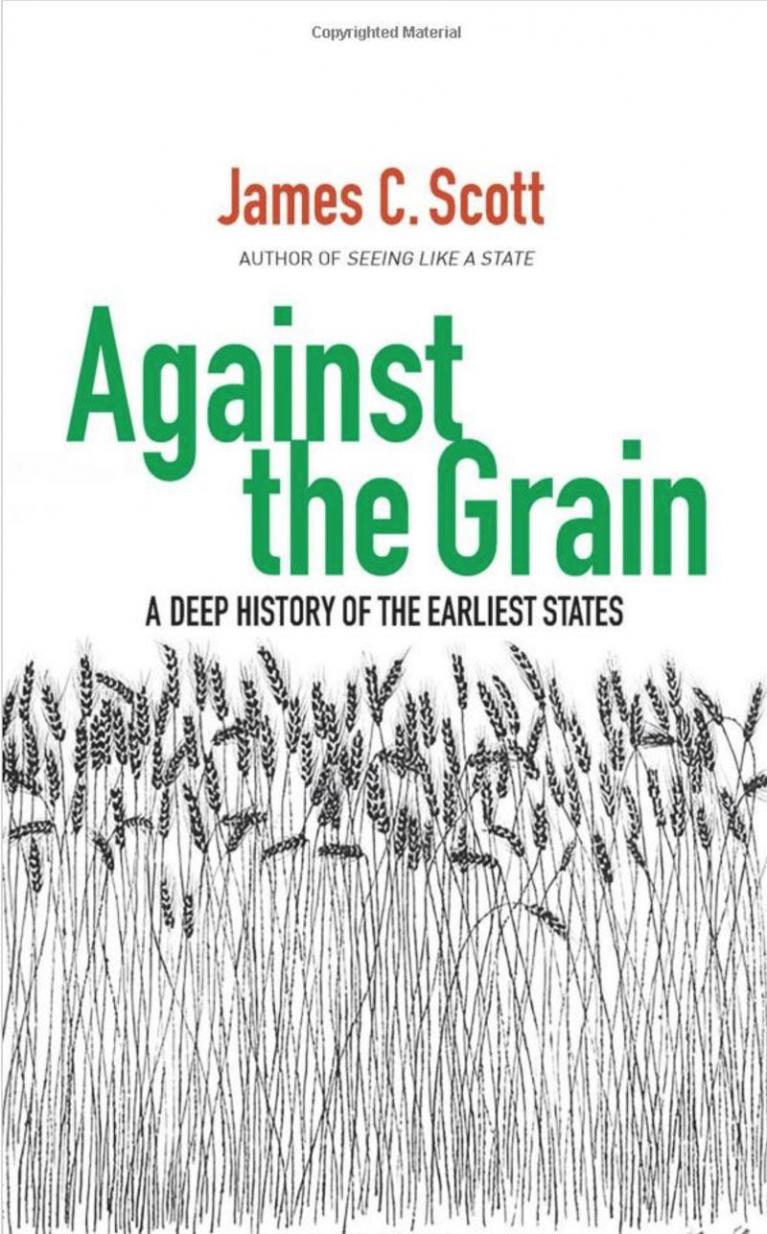

Against the Grain

A Deep History of the Earliest States

This book might be part of the Yale agrarian studies series series.

Listen

Why did humans abandon hunting and gathering for sedentary communities dependent on livestock and cereal grains, and governed by precursors of today’s states? Most people believe that plant and animal domestication allowed humans, finally, to settle down and form agricultural villages, towns, and states, which made possible civilization, law, public order, and a presumably secure way of living. But archaeological and historical evidence challenges this narrative. The first agrarian states, says James C. Scott, were born of accumulations of domestications: first fire, then plants, livestock, subjects of the state, captives, …

Hardcover, 336 Seiten

Sprache: English

Am 22. August 2017 von Yale University Press veröffentlicht.

Mehr anzeigen
ISBN:
978-0-300-18291-0
ISBN kopiert!
OCLC-Nummer:
990684513
Goodreads:
34324534

Auf OpenLibrary ansehen

Auf Inventaire anzeigen

Themen
  • Origin
  • Agriculture and state
  • Agriculture
  • History

Rezensionen

hat Against the Grain von James C. Scott besprochen (Yale agrarian studies series)

A Compelling Political Science Inflected Tour Through Early Societies

This is a great dive into early larger scale societies with a political science lens, positing that ease of taxation of grain was the catalyst for the development of early states. Scott further provides compelling analysis demonstrating the existence of sedentary communities far prior to the first states and why those communities arose, as well as better approaches for understanding what happened when these early civilizations "collapsed" and how to appropriately understand "barbarians." If you've read "The Dawn of Everything," published after this book, many of the themes will be familiar, although the work here is a lot less rigorous. However the political science perspective here is a crucial differentiator, and definitely makes this book reading if you're interested in how humans have lived until extremely recently. Highly recommend