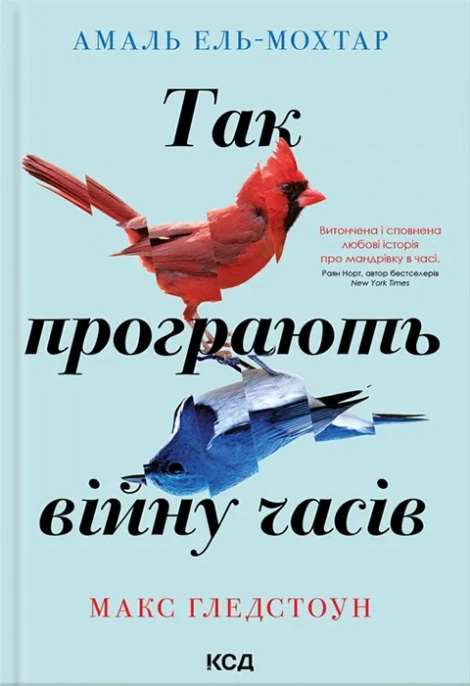

Так програють війну часів

Книга «Так програють війну часів» — це епістолярна повість авторів Амаля Ель-Мохтара й Макса Гледстоуна. Поки світ гине, ворожі організації — тоталітарне Управління й Едем — змагаються за право володіти минулим, а отже й майбутнім. Червоні й Блакитні агенти мандрують нитками часу й корегують історію так, як вигідно саме їм.

Здається, планета, а з ними й організації, приречені на смерть. Та все може змінити один лист: від Блакитної — найкращої агентки Едем — до Червоної. Спілкування насмішок поступово перетвориться на заборонений зв’язок, що може врятувати людство від зникнення. Та …

Hardcover, 208 Seiten

Sprache: Ukrainian

Am 2024 von КСД veröffentlicht.

Mehr anzeigen
ISBN:
978-617-15-0718-0
ISBN kopiert!
Themen
  • science fiction
  • time-traveling
  • epistolary
  • LGBT
  • English literature
  • Fiction, science fiction, general

Rezensionen

Erstaunlich dicht und poetisch

Das Buch ist klein, groß geschrieben, hat viel Whitespace und nicht mal 200 Seiten. Trotzdem habe ich bald zwei Wochen gebraucht, es zu lesen, weil es so dicht gewebt ist.

Red und Blue, die Protagonistinnen sind quasi Spion und Spion aus den alten Mad Heften. Auch sie haben ausgeklügelte Fallen und Fähigkeiten um die verschiedenen Zeig-Strände für ihre Faktion zu gewinnen/zerstören. Und irgendwann verlieben sie sich.

Dabei lernen wir immer mehr über die Art, wie die jeweilige Seite funktioniert: kurz gesagt elaborierte Maschinenwesen VS Blumenwesen. Die Details sind unterhaltsam und fühlen sich rund an — solange man nicht zu genau hinschaut. Der Aufbau ist handwerklich gut, wenn auch nicht überraschend.

Sehr empfehlenswert.

Cute romance with a disappointing sci-fi setting.

Amal El-Mothar and Max Gladsonte's "This is How You Lose the Time War" follows two agents, Red and Blue, on opposite sides of a war that spans all of time and (some of?) space across multiple universes.

Each chapter starts with a snapshot of what each agent is doing to advance their side's cause, whether that's taking part in major historical events or planting the seeds for 'coincidences' in the future, and ends with the discovery of a letter from their counterpart. What begins as acknowledgements of respect, nods across the battlefield, gradually grow into something more.

Fans of science fiction may be disappointed by the lack of focus on the time-traveling, universe-hopping backdrop to this story of star-crossing lovers. Details are sparse, and little is disclosed about the factions or why they are at war other than hints and impressions throughout the book.

The gradual, tip-toeing …

Weird and beautiful but not always up to its own ambition

The letters that make up about half of this book are gorgeously written, and I love the story they tell. The basic idea of the time war is clever, and the descriptions of placetimes the characters find themselves in evocative, sometimes reminiscent of Calvino's Invisible Cities. I devoured this book in a few days.

And yet... something about it felt a little thin or hollow behind its fireworks. I think it was a good artistic choice to leave all technical details out, but I couldn't help but get hung up on the time paradoxes. Not that it's the authors' responsibility to necessarily avoid or solve them, but for me personally they intruded on the suspension of disbelief.

probably not for everyone, but it's very good

it's a magical realist (?) romance in a science fiction Time War setting, an unusual choice, but one that works well, given how strange the consequences of warping causality would be. If you can get ahold of the audio book, it's pretty good, has different readers for Blue and Red.